Kinnect UX Case Study

Kinnect UX Case Study

Designing for Dignity: AI-Powered Caregiving for Families

Designing for Dignity: AI-Powered Caregiving for Families

2025 | UX for Healthcare | UX Researcher | Digital Health | AI Design

2025 | UX for Healthcare | UX Researcher | Digital Health | AI Design

2025 | UX for Healthcare | UX Researcher | Digital Health | AI Design

Objective & Background

Objective & Background

Kinnect was created during a two-week Transition into UX for Healthcare course through HXRlabs. I chose this project because my friends, family, and I are personally beginning to face the challenge of supporting aging parents while balancing careers, families, and distance.

Kinnect was created during a two-week Transition into UX for Healthcare course through HXRlabs. I chose this topic as my project because it's one that my friends, family, and I are beginning to face — supporting aging parents while balancing careers, families, and distance.

Kinnect was created during a two-week Transition into UX for Healthcare course through HXRlabs. I chose this topic as my project because it's one that my friends, family, and I are beginning to face — supporting aging parents while balancing careers, families, and distance.

This concept explores how AI and empathetic design can help adult children care for their parents from afar — strengthening trust, visibility, and emotional connection without taking control away from care recipients. The goal was to help caregivers feel supported and confident while preserving their parents’ dignity, independence, and sense of self.

This concept explores how AI and empathetic design can help adult children care for their parents from afar — strengthening trust, visibility, and emotional connection without taking control away from care recipients. The goal was to help caregivers feel supported and confident while preserving their parents’ dignity, independence, and sense of self.

This concept explores how AI and empathetic design can help adult children care for their parents from afar — strengthening trust, visibility, and emotional connection without taking control away from care recipients. The goal was to help caregivers feel supported and confident while preserving their parents’ dignity, independence, and sense of self.

Through social listening, competitve analysis, and heuristic evaluation, I identified key emotional and usability gaps in digital caregiving tools — focusing on research and early concept development to uncover opportunities for a more human-centered, emotionally aware caregiving experience.

Through social listening, competitve analysis, and heuristic evaluation, I identified key emotional and usability gaps in digital caregiving tools — focusing on research and early concept development to uncover opportunities for a more human-centered, emotionally aware caregiving experience.

Through social listening, competitve analysis, and heuristic evaluation, I identified key emotional and usability gaps in digital caregiving tools — focusing on research and early concept development to uncover opportunities for a more human-centered, emotionally aware caregiving experience.

Overview

Problem

Existing caregiving tools focus on logistics—like scheduling and medication—but overlook the human side of caregiving. Families supporting aging parents from a distance often feel anxious, disconnected, and unsure how to help without overstepping. The challenge was designing technology that strengthens connection without reducing independence.

Existing caregiving tools focus on logistics—like scheduling and medication—but overlook the human side of caregiving. Families supporting aging parents from a distance often feel anxious, disconnected, and unsure how to help without overstepping. The challenge was designing technology that strengthens connection without reducing independence.

Goal

Kinnect set out to explore how AI and human-centered design could make caregiving feel more supportive and less stressful. The focus was on creating calm, clarity, and confidence through empathetic interactions—ensuring both caregivers and care recipients feel respected and in control.

Kinnect set out to explore how AI and human-centered design could make caregiving feel more supportive and less stressful. The focus was on creating calm, clarity, and confidence through empathetic interactions—ensuring both caregivers and care recipients feel respected and in control.

Solution

Kinnect reimagines digital caregiving as a collaborative partnership. It combines AI insight with emotional design, creating shared visibility, reassurance, and gentle guidance for families. Instead of overwhelming users with data, it prioritizes understanding and trust—helping caregivers feel capable and loved ones feel understood.

Kinnect reimagines digital caregiving as a collaborative partnership. It combines AI insight with emotional design, creating shared visibility, reassurance, and gentle guidance for families. Instead of overwhelming users with data, it prioritizes understanding and trust—helping caregivers feel capable and loved ones feel understood.

Role

UX Designer — Led research, analysis, and concept development; conducted user interviews; and designed early caregiver-focused wireframes.

UX Designer — Led research, analysis, and concept development; conducted user interviews; and designed early caregiver-focused wireframes.

Methods Used

4

Social Listening Threads

(r/agingparents, r/caregivers, r/genx, r/aging)

10

Heuristics Criteria

(NN/g to uncover pain points and opportunities)

4

Competitive Analysis

(CareZone, CareLoop, Medisafe, AARP caregiving app)

10

Heuristics Criteria

(r/agingparents, r/caregivers, r/genx, r/aging)

4

Competitive Analysis

(CareZone, CareLoop, Medisafe, AARP caregiving app)

Key Insights

Caregivers want more than organization — they need reassurance, helpful insights, and human warmth.

Caregivers want more than organization — they need reassurance, helpful insights, and human warmth.

They're seeking understanding, guidance, and encouragement — digital tools that help them feel supported, confident, and less alone in their caregiving journey.

They're seeking understanding, guidance, and encouragement — digital tools that help them feel supported, confident, and less alone in their caregiving journey.

Competitive Analysis

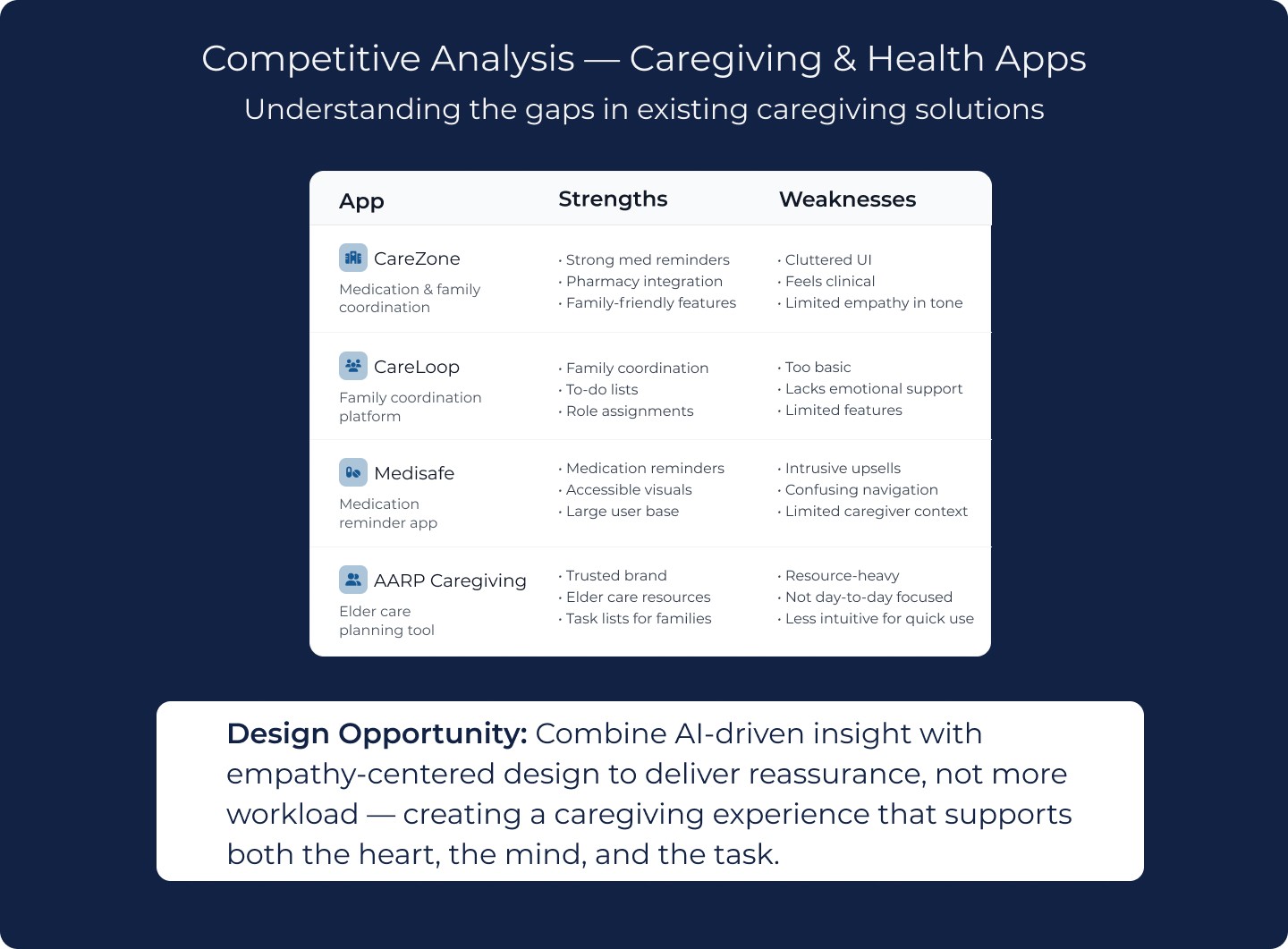
A review of leading caregiving and health apps revealed strong functionality but limited emotional design. Apps like CareZone excel at organization, while Medisafe and CareLoop focus on reminders — yet none integrate shared empathy or context awareness

A review of leading caregiving and health apps revealed strong functionality but limited emotional design. Apps like CareZone excel at organization, while Medisafe and CareLoop focus on reminders — yet none integrate shared empathy or context awareness

Design Opportunity: Combine AI insight with empathy-driven UX to create reassurance, not workload.

Design Opportunity: Combine AI insight with empathy-driven UX to create reassurance, not workload.

Heuristic Evaluation

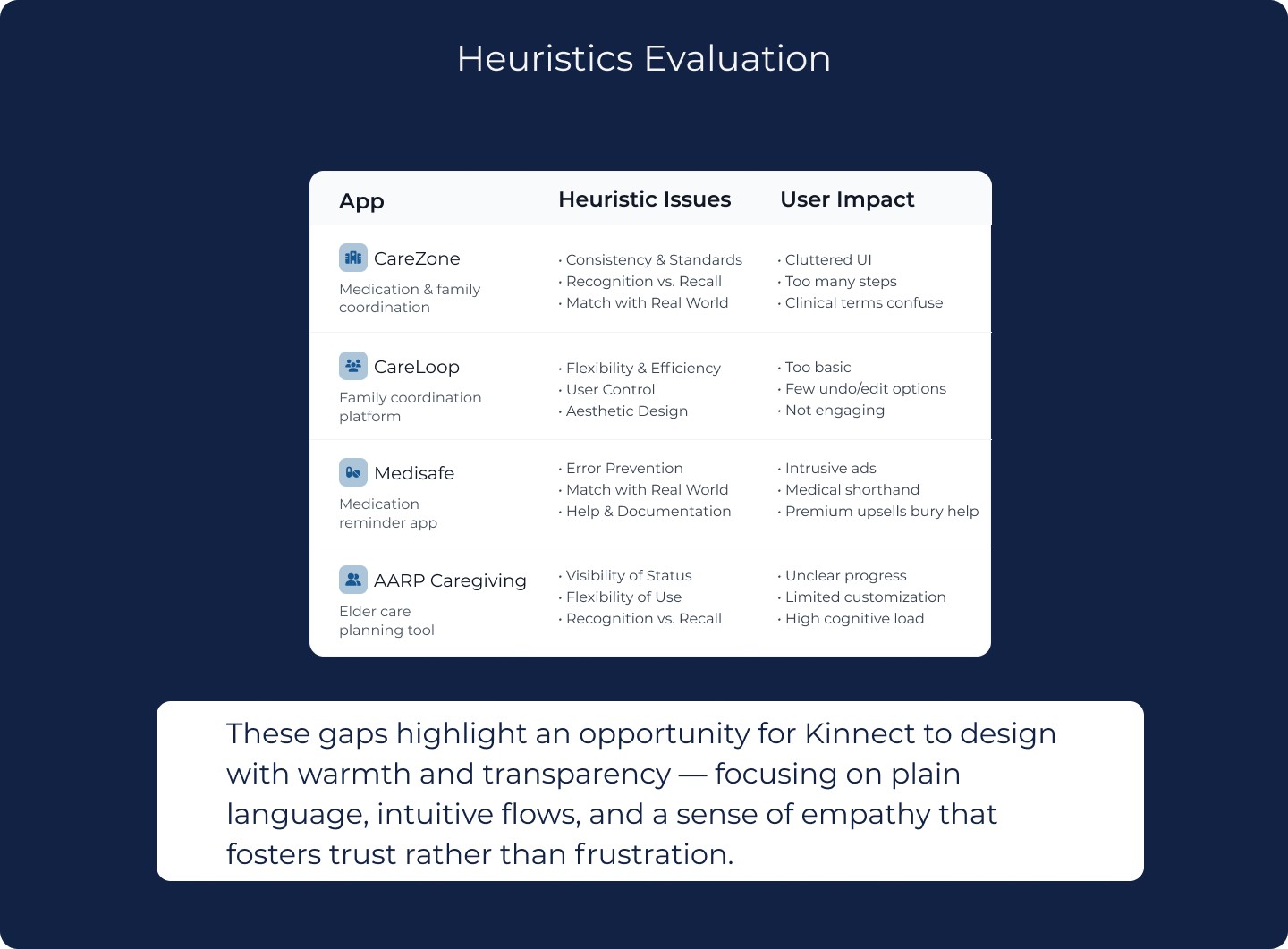
Using Nielsen's 10 Usability Heuristics, I examined tone, clarity, and accessibility. Findings revealed inconsistent system feedback, confusing navigation, and a lack of emotional resonance.

Using Nielsen's 10 Usability Heuristics, I examined tone, clarity, and accessibility. Findings revealed inconsistent system feedback, confusing navigation, and a lack of emotional resonance.

Design

Concept Development

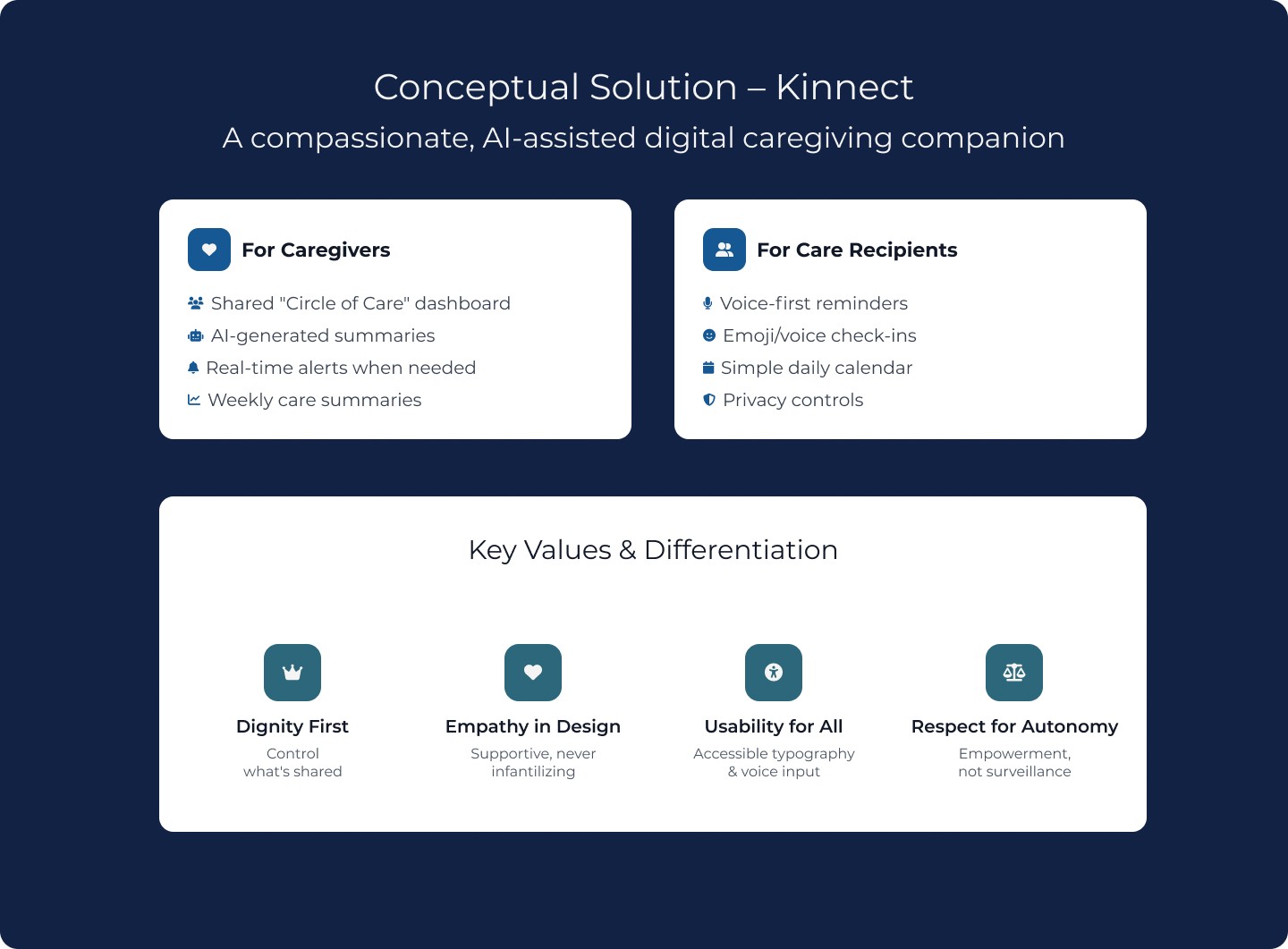
Early exploration focused on AI as an Invisible assistant — simplifying care data, providing gentle emotional cues, and strengthening relationships instead of replacing them.

Early exploration focused on AI as an Invisible assistant — simplifying care data, providing gentle emotional cues, and strengthening relationships instead of replacing them.

Core Design Focus Areas

• Caregiver dashboard for shared visibility

• Emotional support hub for empathy and reflection

• AI summaries that humanize data through tone and storytelling

• Caregiver dashboard for shared visibility

• Emotional support hub for empathy and reflection

• AI summaries that humanize data through tone and storytelling

Design Goal

Make technology feel like a supportive partner — not a supervisor.

Make technology feel like a supportive partner — not a supervisor.

Wireframes

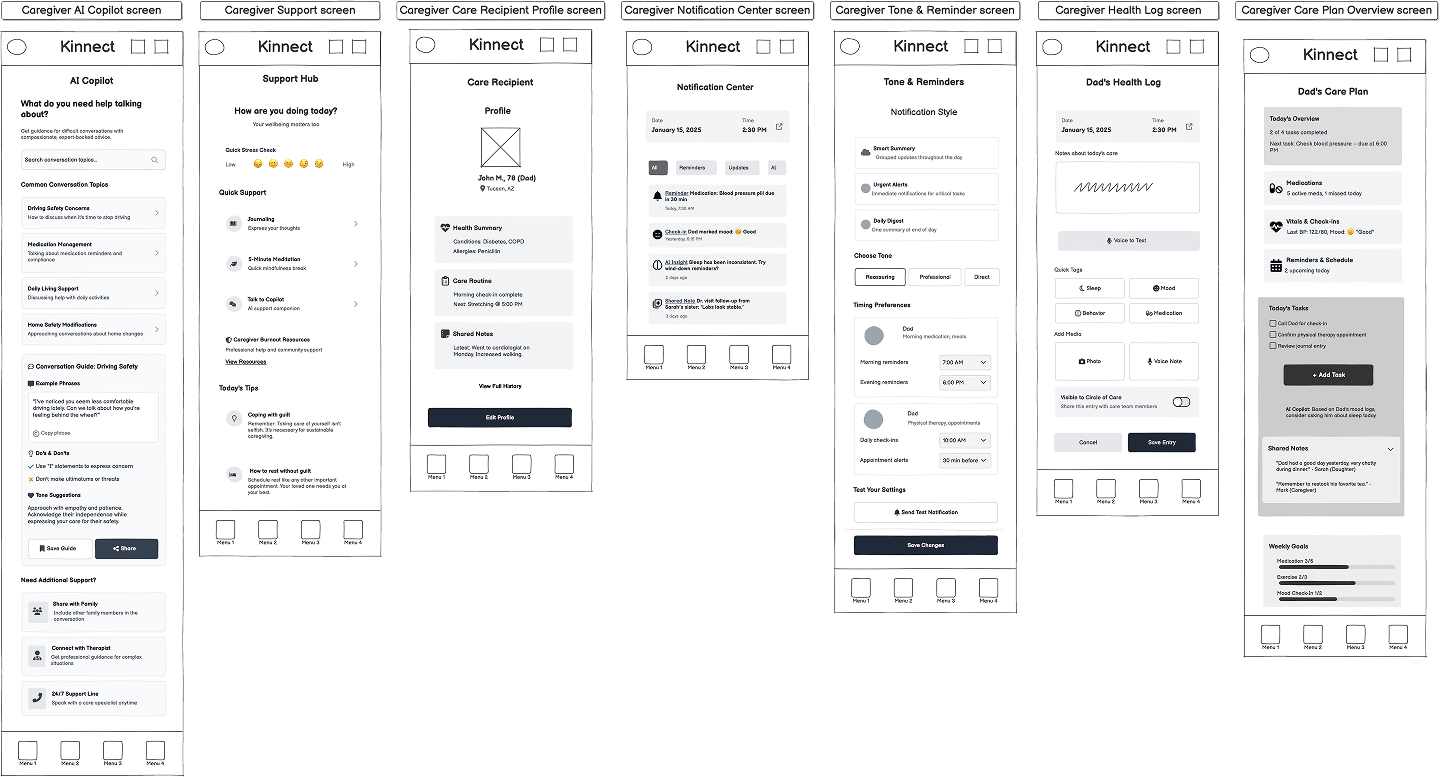
These initial wireframes focused on the caregiver experience, emphasizing simplicity, emotional reassurance, and clarity of information. Each screen was designed to reduce cognitive load while maintaining a sense of empathy and control

These initial wireframes focused on the caregiver experience, emphasizing simplicity, emotional reassurance, and clarity of information. Each screen was designed to reduce cognitive load while maintaining a sense of empathy and control

The seven key screens capture Kinnect's foundational flow — from emotional support to daily care coordination:


  1. AI Copilot: Provides guided conversation starters to help caregivers handle difficult discussions (e.g., driving safety, medication management).

  2. Support Hub: Offer mood check-ins, quick wellness tips, and burnout prevention resources.

  3. Care Recipient Profile: Centralizes key health information, daily routines, and shared notes for context at a glance.

  4. Notification Center: Displays timely alerts and insights without overwhelming the user.

  5. Tone & Reminders: Allows personalization of reminder style and timing, respecting different communication preferences.

  6. Health Log: Enables caregivers to track daily updates, add photos or voice notes, and share insights with the care circle.

  7. Care Plan Overview: Summarizes key goals, tasks, and progress — keeping the caregiver informed and reassured.

Together, these wireframes visualize Kinnect's holistic caregiving loop:


Emotional check-in
Contextual support
Action tracking
Shared understanding

Conclusion & Next Steps

Reflection

This short-term project highlighted how UX design can bridge emotional and practical caregiving needs.

Designing for healthcare means designing for trust, empathy, and dignity — not just function.
Digital Health
Accessibility
Wireframes
Conceptual Design
Digital Health
Accessibility
Wireframes
Conceptual Design
Digital Health
Accessibility
Wireframes
Conceptual Design